The geometry of a conversation
The shape of a table is a social contract written in furniture. Before you assign a single guest to a seat, the table shape has already decided something important: who can talk to whom, and who will spend the evening performing acoustics across an impossible distance.
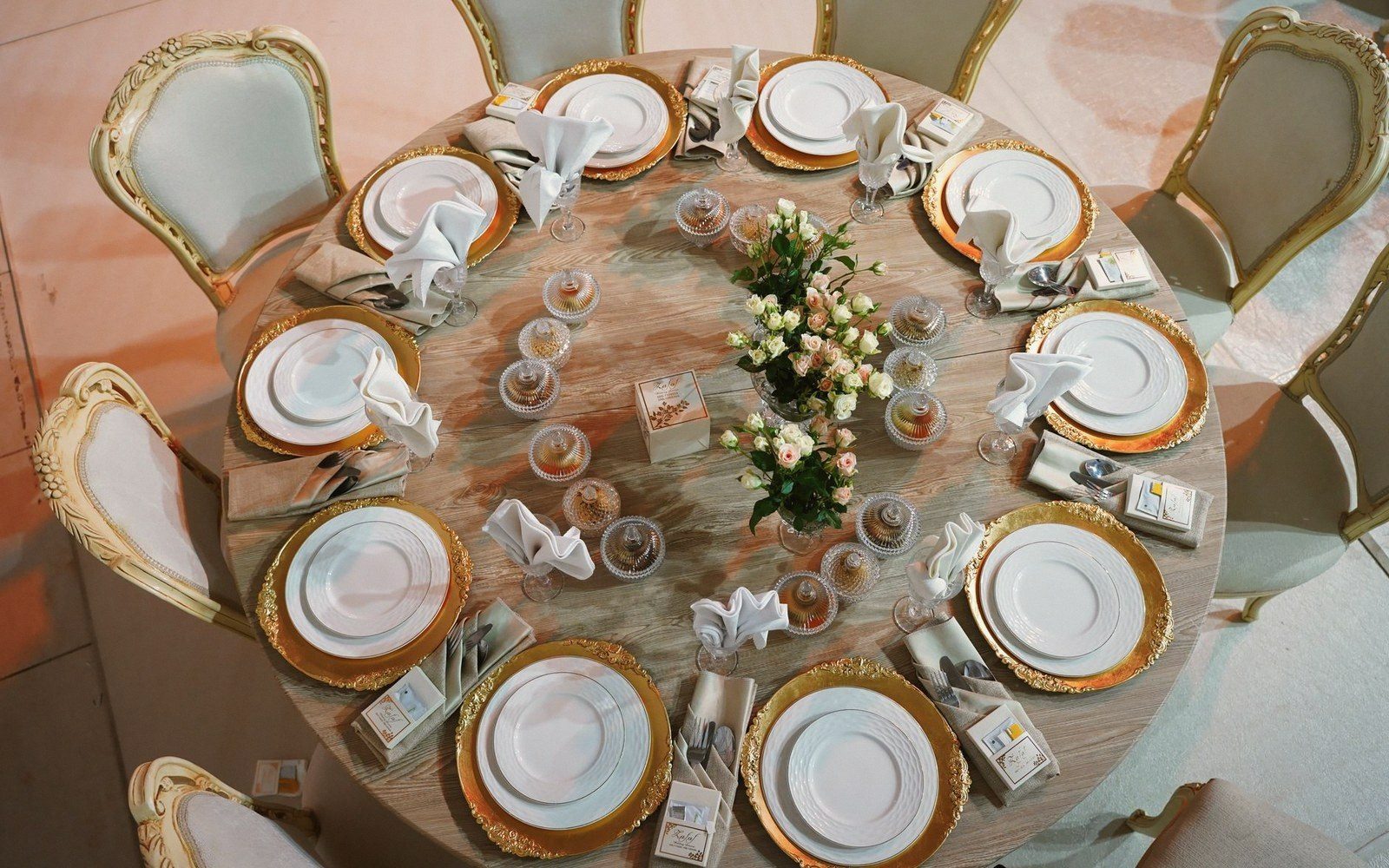
Round tables — typically set for six, eight or ten, occasionally twelve at a squeeze — close the conversational loop. Everyone at a round eight sits within roughly a metre and a half of the person directly opposite, and the arc between neighbours means that a group of six or eight can sustain something close to a single conversation if they want to, or split into pairs and reform without the geometry fighting them. Nobody is stranded at an end. Nobody has a back-of-the-head relationship with the person across the table. The shape is forgiving.
Long tables — banquet or trestle configuration, common when the venue demands it or the couple wants a certain aesthetic — do something quite different. At a table of twelve, the guests at one end are effectively at a different party from the guests at the other. Conversational reach at a rectangular table is roughly two seats in each direction: the person opposite you, the two either side, and at a stretch the person diagonally adjacent. Beyond that, you are miming. A long table of twelve contains, in practice, three or four overlapping conversational zones that shift across the meal, not one shared experience.
This is not an argument against long tables. It is an argument for understanding what you are choosing.
What this means for the plan
If round tables are your format, the relevant unit is the table, and the problem is filling each one with a group that can function. A table of eight where two people actively dislike each other is a problem of a particular, contained kind — uncomfortable, but bounded. The seating plan is a graph problem at the level of individual relationships, and the round table makes that graph smaller and more legible. You are assigning people to sub-communities of eight, and the edges that matter are within each cluster.

Long tables shift the unit of the problem. Because conversational zones are local, the sequence of seats matters more than the table as a whole. Someone placed third from the end of a long table of fourteen has essentially been assigned their neighbours: the person opposite and the two on each side. The exact person in seat four versus seat five can be consequential in a way it rarely is at a round six. The plan becomes a sequence problem, not just a grouping problem.
The practical implication: if you are planning long tables, think in runs of three or four rather than in whole tables. Who occupies the middle stretch of a long table of fourteen? That central cluster will have the most conversational flexibility; the ends are more isolated. Put the most self-sufficient guests — comfortable alone in company, or already in established pairs — toward the ends. Put guests who need a wider group, or who you most want to have a good time, in the middle.
Round tables have their own structural pressure. They reward having one or two strong social connectors per table — people who will talk across the circle and bring quieter guests in. A round table of eight that contains six introverts and no natural catalyst can be very quiet. The shape enables a group conversation; it does not guarantee one.
Mixing formats
Many rooms use both: round tables for the main floor, a long table at the front or centre for family or the wedding party. This is workable, but it creates a perceptual hierarchy — the long table reads as the principal one, and guests at round tables are arranged around it. That may be exactly the effect you want. It also means you are running two different placement logics simultaneously, which is more work, not less.
You are assigning people to sub-communities of eight, and the edges that matter are within each cluster.
Whatever you choose: commit early, because the table shape determines not just the floor plan but the total seat count, and the caterer's final number comes with a hard deadline. Changing from round eights to long twelves after the floor plan is confirmed is not a décor question. It is an arithmetic restart.