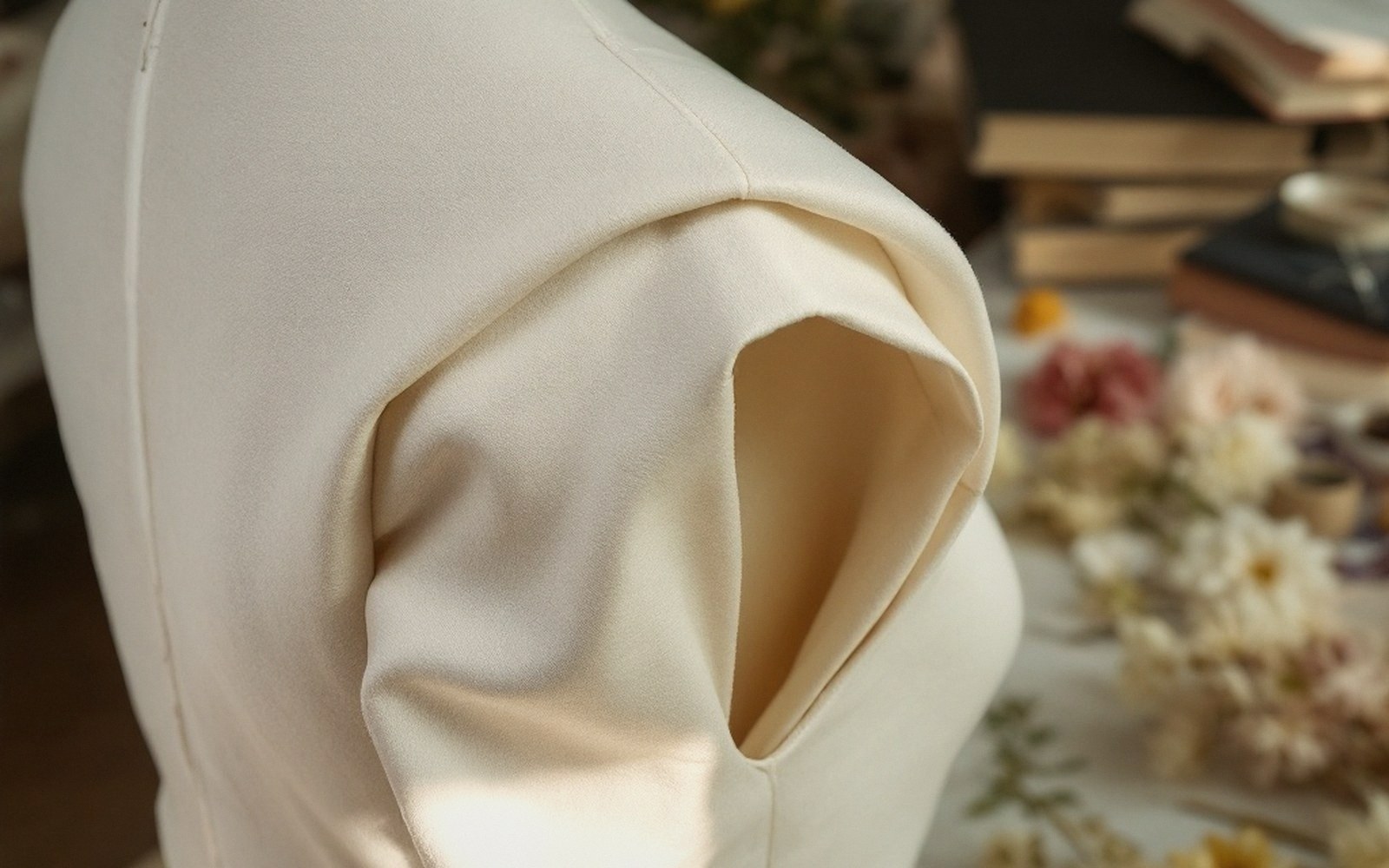
A fitter's fixed points — and everything else is negotiable
The fitting room conversation always begins the same way: what can we change? The honest answer is almost everything — except the two things that actually matter.

Shoulders and armholes are structural. They are cut and sewn before the bodice is assembled, and by the time a garment reaches a first fitting the shoulder seam is where it is. Moving it is not an alteration; it is a rebuild. The shoulder point must sit at the edge of the shoulder bone — not creeping down the arm, not drawn up toward the neck — because every other measurement in the upper body hangs from that single fixed point. The sleeve, the neckline depth, the side seam, the bust dart: all of them are calibrated to a shoulder position. Move the shoulder and you invalidate every one of them.
The armhole is the companion constraint. Its shape — the curve from the front notch around the underarm and back to the shoulder — determines both how the sleeve falls and how the whole bodice moves when the wearer lifts an arm or turns. A too-shallow armhole binds; a too-deep one gaps and slips. Correcting either at a late fitting means re-cutting the bodice and re-setting the sleeve from scratch. Most workrooms will quote this honestly as a separate job at a separate price, if they will take it on at all.
Everything else is genuinely movable. The side seams can be let in or taken out within the limits of the seam allowance left at cut. Hems can go up or down. Boning can be repositioned. Straps can be shortened or lengthened. A back zip can be converted to a laced panel to allow for fluctuation. Even a neckline can be lowered a little, and a high neck added with a separate modesty piece. These are real changes, done in a single fitting cycle by a skilled hand.
The practical implication is straightforward: when you are choosing between two garments and one fits the shoulders and one does not, choose the shoulder fit every time. A waist that is a little too small can usually be corrected. The shoulder that sits an inch too far down the arm cannot, not without a cost in time and money that often exceeds the garment's own value.

Fitters will sometimes soften this. They will say things like we can look at it or it depends on the construction. Both may be true. But the underlying fact does not change: a sample size is always a starting point, and the shoulder is the one starting point that has almost no room to move.